



|
Celebrating 25 years delivering DNA and RNA purification solutions! |
$0.00 – $5,426.70Price range: $0.00 through $5,426.70
CE-IVD marked kit is available: Mag-Bind® Blood & Tissue DNA HDQ 96 Kit CE IVD – (omegabiotek.com)
All Mag-Bind® kits can be automated on most programmable robotic platforms, liquid handlers or magnetic processors. Learn more.
Off-the-shelf product doesn’t suit your needs? We’ll work with you to develop a customized product. Learn more.
Dedicated applications support will consult with you to develop and implement an automated solution that fits your specifications. Learn more.
Scripts available for all Mag-Bind® Kits for most open liquid handlers and common magnetic processors including the MagBinder® Fit24. Visit Automated Solutions for more information.
The Mag-Bind® Blood & Tissue DNA HDQ 96 Kit is designed for the rapid and reliable isolation of high-quality genomic DNA from 100-250 μL of blood samples, 500 μL saliva, swabs, mouse tails, dried blood spots, tissues, or 5 x 10⁶ cultured cells. Mag-Bind® Particles HDQ provide quick magnetic response times, thereby reducing overall processing time.
Our cutting-edge Mag-Bind® technology reduces overall processing time by providing a quick magnetic response. This kit combines the reversible nucleic acid-binding properties of Mag-Bind® paramagnetic particles with the proven efficiency of Omega Bio-tek’s blood and tissue DNA isolation system to provide a rapid and robust method for the isolation of DNA from a variety of biological samples. The system yields high-quality DNA that is suitable for direct use in most downstream applications such as amplification, NGS, and enzymatic reactions.
Ready-to-implement protocols are available for the following platforms:
For Research Use Only. Not for use in diagnostic procedures.
| FEATURES | SPECIFICATIONS |
|---|---|
| Starting Amount | 100-250 μL blood samples, saliva, swabs, mouse tails, dried blood spots or 5 x 10⁶ cultured cells. |
| Elution Volume | 50-200 µL |
| Technology | Magnetic Beads |
| Processing Mode | Automated, Manual |
| Throughput | 8 – 384 |
| Note | Downstream applications: NGS, qPCR, microarray |
| ITEM | AVAILABLE SEPARATELY |
|---|---|
| Mag-Bind® Particles HDQ | Call for Pricing |
| AL Buffer | View Product |
| TL Buffer | View Product |
| HDQ Binding Buffer | View Product |
| VHB Buffer | View Product |
| SPM Buffer | View Product |
| Proteinase K Solution | View Product |
| Elution Buffer | View Product |
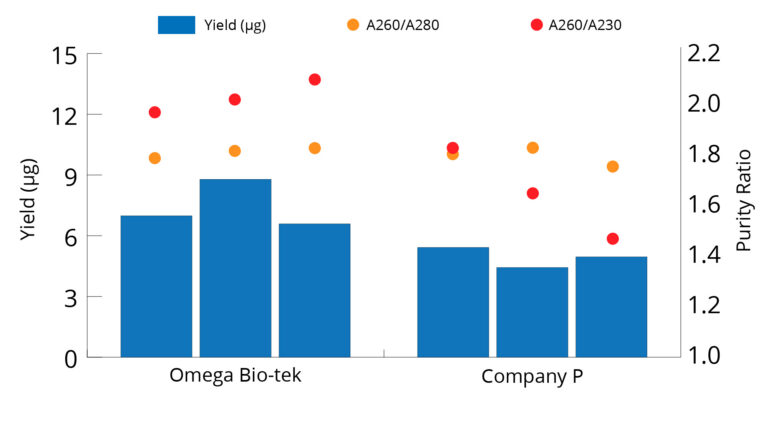
Figure 1. Genomic DNA was extracted from 250 µL of whole blood (n=3) using the Mag-Bind® Blood & Tissue DNA HDQ 96 Kit processed on the MagBinder® Fit24, as well as using an equivalent, competing kit on the competitor’s magnetic processor. Yield and purity values were determined using Thermo Scientific’s NanoDrop™ 2000c. It can be seen here that the Mag-Bind® Blood & Tissue DNA HDQ Kit on the MagBinder® Fit24 produces higher yields of high-quality DNA than Company P’s kit.
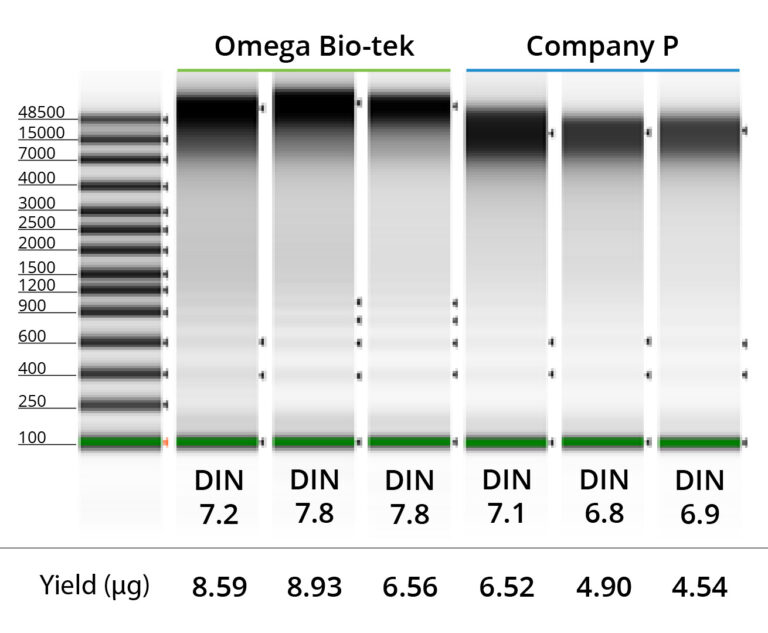
Figure 2. Genomic DNA was extracted from 250 µL of whole blood (n=3) using the Mag-Bind® Blood & Tissue DNA HDQ 96 Kit processed on the MagBinder® Fit24, as well as using an equivalent, competing kit on the competitor’s magnetic processor. DNA yield and integrity were analyzed via Agilent’s TapeStation® 4150, and the results indicated higher yields of high-integrity DNA (DIN >7.2) were extracted using the Mag-Bind® Blood & Tissue DNA HDQ 96 Kit on the MagBinder® Fit24 vs Company P’s kit.
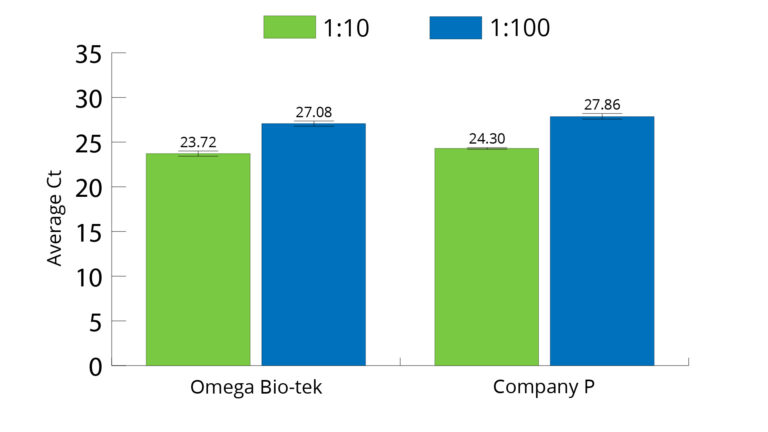
Figure 3. Genomic DNA was extracted from 250 µL of whole blood (n=3) using the Mag-Bind® Blood & Tissue DNA HDQ 96 Kit processed on the MagBinder® Fit24, as well as using an equivalent, competing kit on the competitor’s magnetic processor. Downstream suitability was assessed by qPCR using 10-fold and 100-fold dilutions, along with rpl13a primers. The average ΔCts for the Mag-Bind® Blood & Tissue DNA HDQ 96 Kit and the competing kit were 3.37 and 3.56, respectively. These results indicate inhibitor-free DNA extraction from both kits.
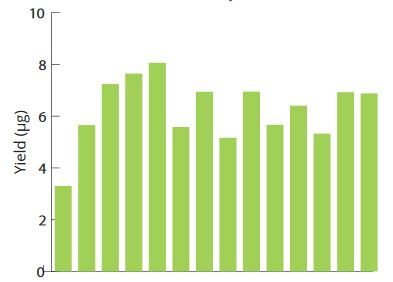
Figure 4. DNA yield from 200 µL whole blood extracted using the Mag-Bind® Blood & Tissue DNA HDQ 96 Kit on the ABI MagMAX 96 instrument. DNA yield was determined by PicoGreen® quantification.
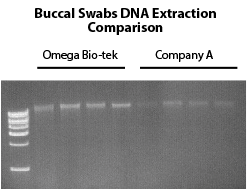
Figure 5. Genomic DNA was extracted from buccal swab samples using Omega Bio-tek’s Mag-Bind® Blood & Tissue DNA HDQ 96 Kit and Company A’s genomic DNA extraction kit. 10% of DNA extracted from each sample was analyzed on a 0.8% agarose gel.
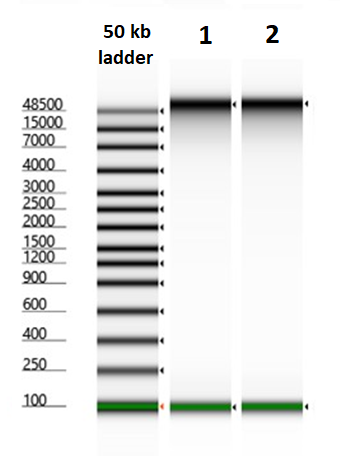
Figure 6. TapeStation® analysis of genomic DNA purified from 250 µL of whole blood using Omega Bio-tek’s Mag-Bind® Blood & Tissue DNA 96 Kit (M6399) automated on Hamilton’s Firefly NIMBUS® 96. TapeStation® analysis software estimates the molecular weight of the purified DNA to be >60kb.
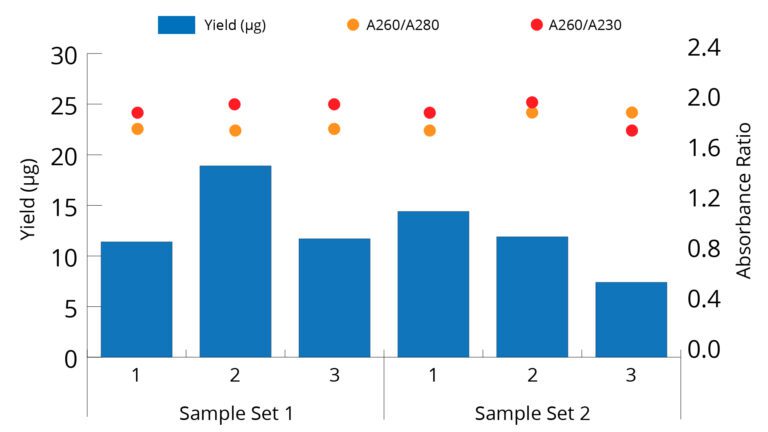
Figure 7. Genomic DNA was extracted from 100 µL buffy coat using the Mag-Bind® Blood & Tissue DNA HDQ 96 Kit automated on the MagBinder® Fit24. Yield and quality were analyzed via Thermo Scientific’s NanoDrop® 2000c. The results indicate consistent high-yielding DNA with excellent purity ratios.
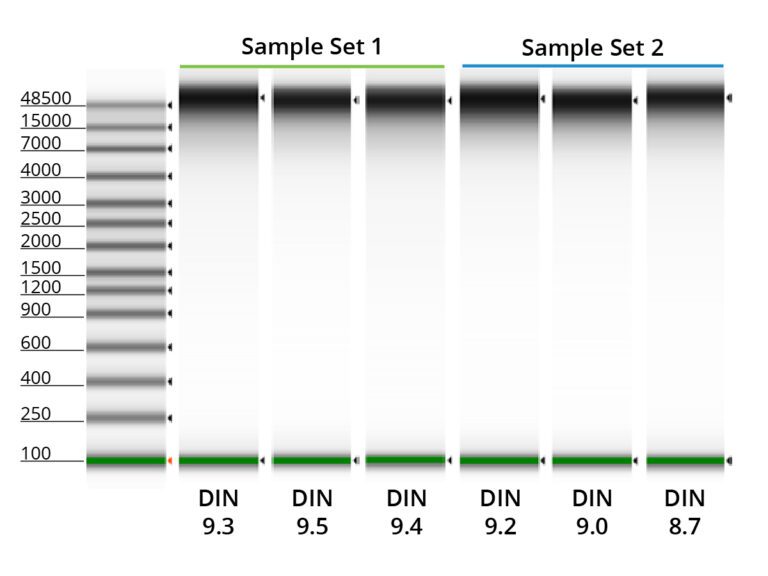
Figure 8. TapeStation® analysis of purified DNA from 100 µL buffy coat showing high molecular weight DNA >60 kb and high DIN scores (>9.2) indicating high integrity intact DNA extracted using Mag-Bind® Blood & Tissue DNA HDQ 96 Kit automated on the MagBinder® Fit24.
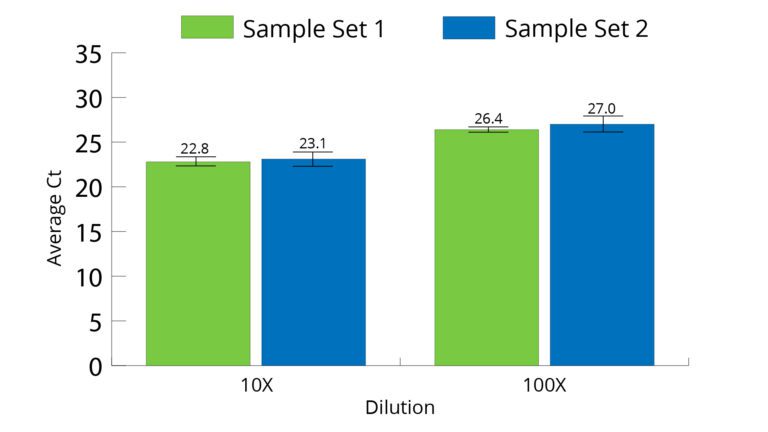
Figure 9. Average Ct values obtained on 10X and 100X dilutions of purified DNA extracted using Mag-Bind® Blood & Tissue DNA HDQ 96 Kit automated on the MagBinder® Fit24. The Ct values differed by ~ 3.3 cycles per 10-fold dilution indicating inhibition-free and efficient downstream qPCR analysis.
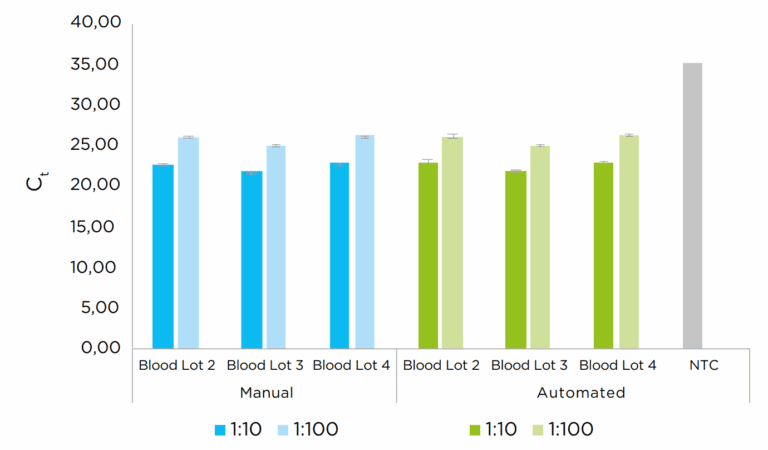
Figure 10. DNA was extracted from 250 µL of whole blood using the Mag-Bind® Blood & Tissue Kit automated on the Tecan Dreamprep. Average Ct values obtained from amplifying the purified DNA following the automated and manual protocols using Omega Bio-tek’s Mag-Bind Blood & Tissue DNA HDQ 96 Kit. A No Template Control (NTC) was added as control to the different blood lot amplifications and to monitor for potential contamination.
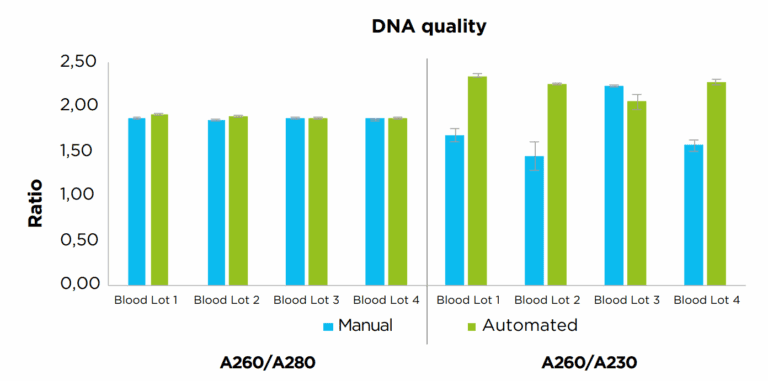
Figure 11. DNA was extracted from 250 µL of whole blood using the Mag-Bind® Blood & Tissue Kit automated on the Tecan Dreamprep. The purity of DNA isolated using manual and automated protocols was analyzed through spectrophotometry focusing on A260/A280 and A260/A230 ratios.
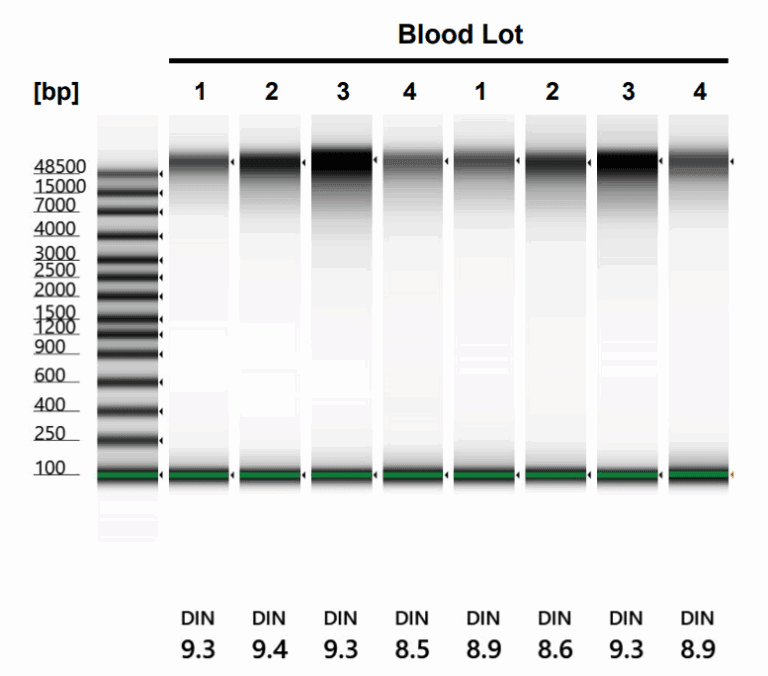
Figure 12. DNA was extracted from 250 µL of whole blood using the Mag-Bind® Blood & Tissue Kit automated on the Tecan Dreamprep. TapeStation Analysis performed on DNA extracted from blood samples using an automated protocol on the Tecan DreamPrep NAP.
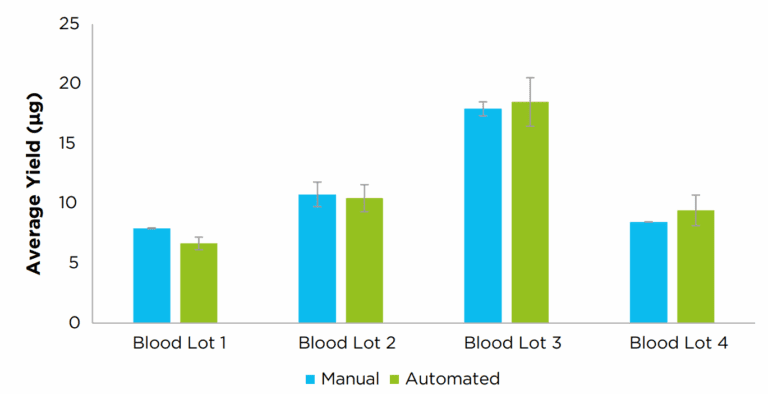
Figure 13. DNA was extracted from 250 µL of whole blood using the Mag-Bind® Blood & Tissue Kit automated on the Tecan Dreamprep. The DNA yield was determined using Thermo Scientific’s NanoDrop 2000c. The average DNA yields from manual and automated extractions were found to be comparable.
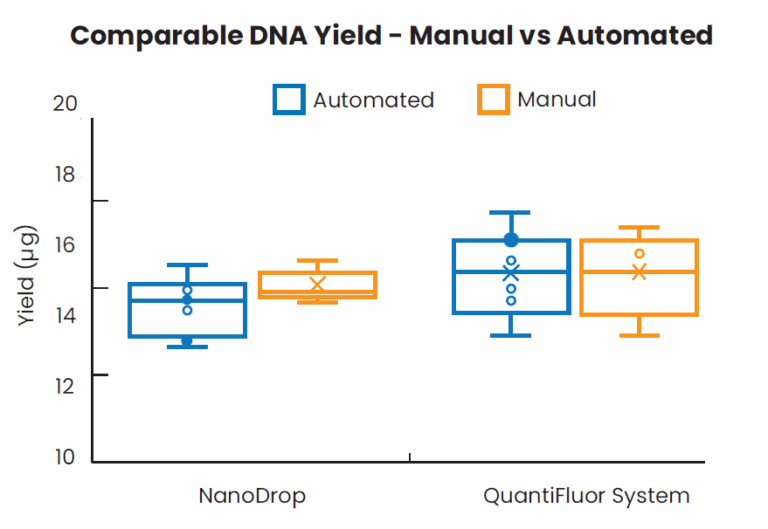
Figure 14. DNA was extracted from 250 µL of whole blood samples and was eluted in 100 µL volume using the Tecan Fluent 780. The DNA yield was determined using Thermo Scientific’s NanoDrop 2000c and Promega’s QuantiFluor dsDNA system. The average DNA yield from manual and automated extractions were found to be comparable and not significantly different (Tukey’s post-hoc analysis; p>0.05).
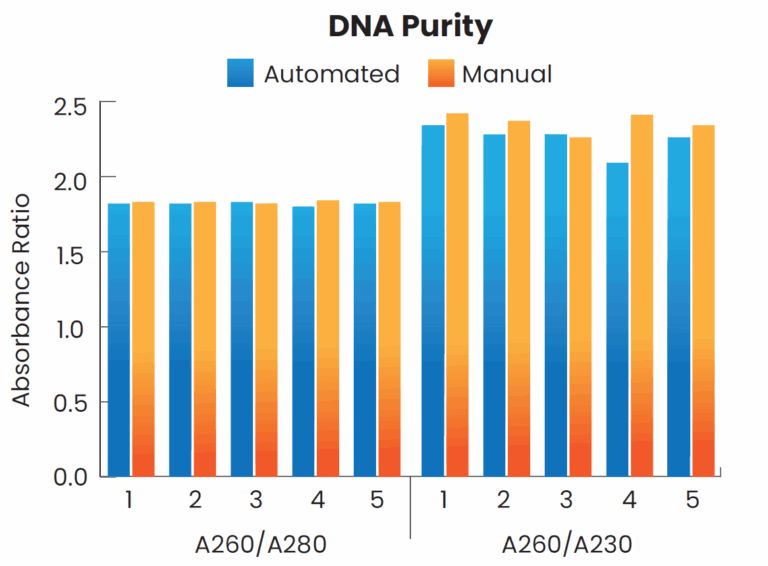
Figure 15. DNA was extracted from 250 µL of whole blood samples and was eluted in 100 µL volume using the Tecan Fluent 780. The purity of DNA isolated using manual and automated protocols was analyzed through spectrophotometry focusing on A260/A280 and A260/A230 ratios.
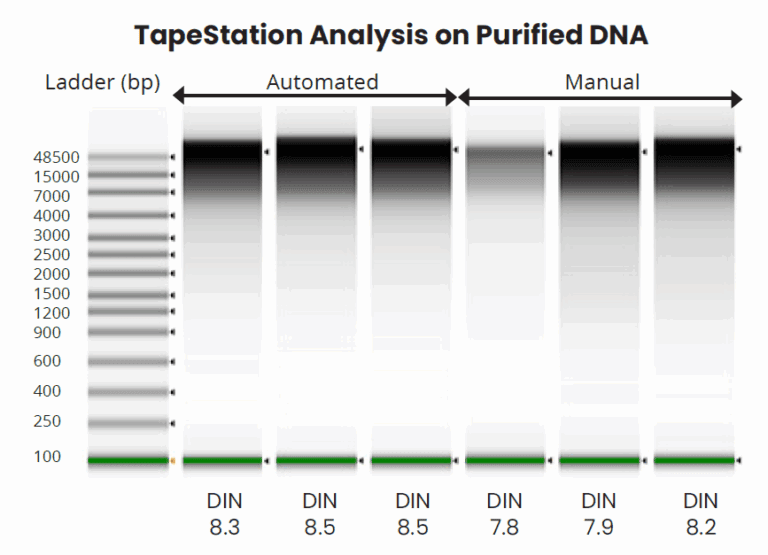
Figure 16. TapeStation analysis performed on the DNA extracted from 250 μL of blood following protocol automated on Tecan Fluent 780 workstation and protocol performed manually.
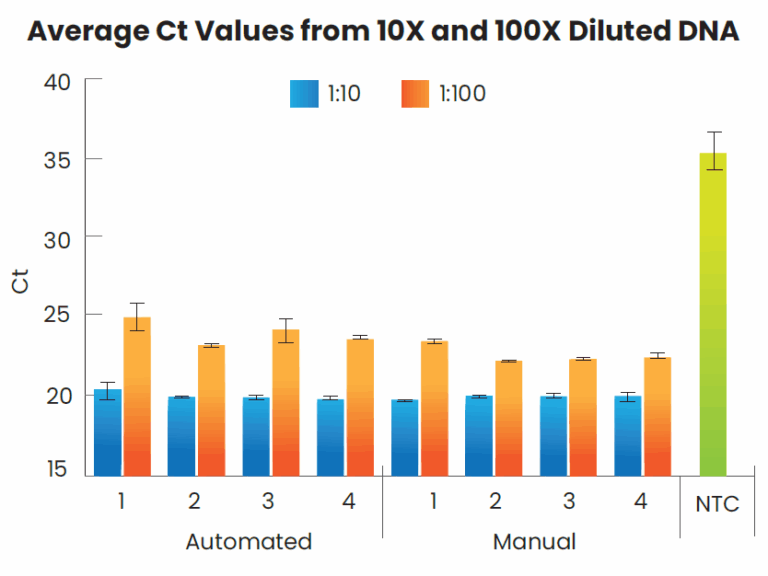
Figure 17. DNA was extracted from 250 µL of whole blood samples and was eluted in 100 µL volume. Average Ct values obtained amplifying the purified DNA following the automated protocol for the Tecan Fluent 780, as well as manual protocols using Omega Bio-tek’s kit.
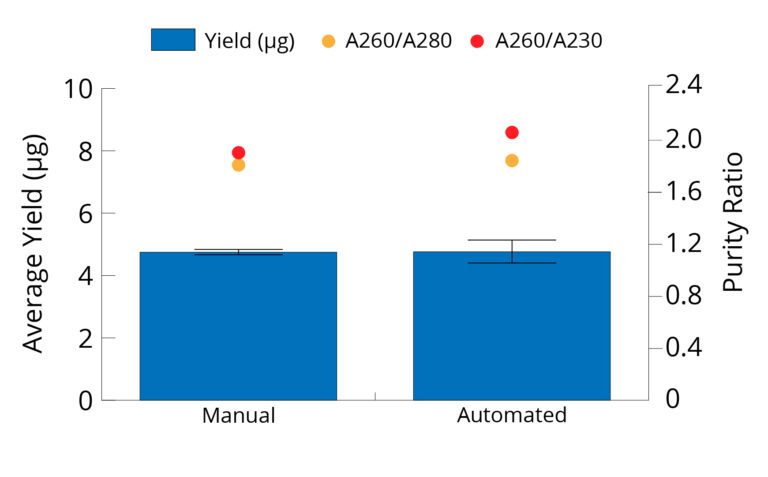
Figure 18. Genomic DNA was extracted from 250 µL of whole blood using the Mag-Bind® Blood & Tissue DNA HDQ 96 Kit both manually, following manufacturer’s instructions, and automated on the Dynamic Devices Lynx system. DNA yield and quality were analyzed via Thermo Scientific’s NanoDrop® 2000c. The average yields of DNA between manual and automated extraction methods were found to be comparable, while purity ratios improved for the automated method.
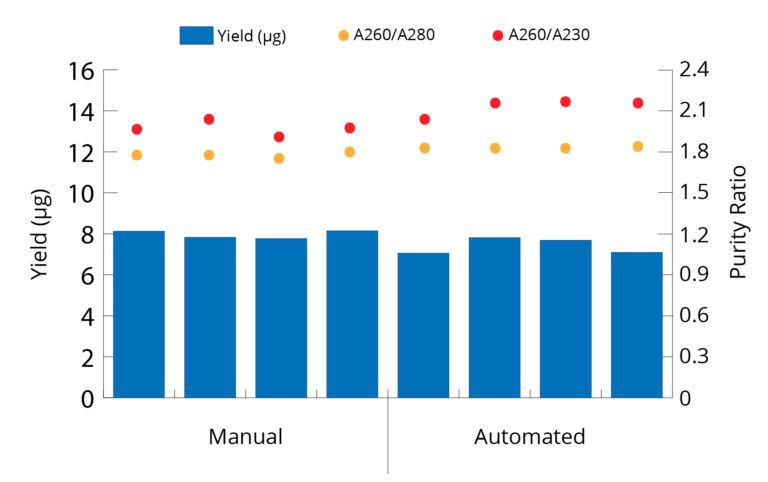
Figure 19.Genomic DNA was extracted from 100 µL pooled saliva using the Mag-Bind® Blood & Tissue HDQ 96 Kit automated on the Hamilton Microlab® STAR™. Yield and quality were analyzed via Thermo Scientific’s NanoDrop® 2000c. The results indicate comparable yield and purity ratios between manual and automated extraction methods.
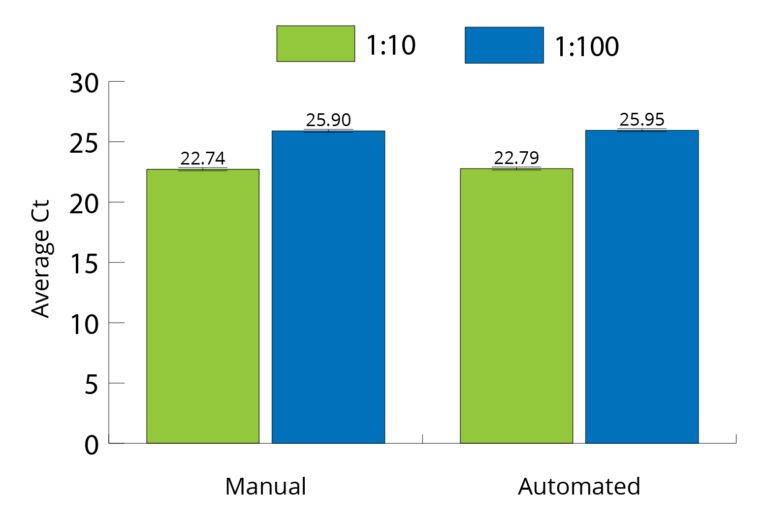
Figure 20. Genomic DNA was extracted from 100 µL pooled saliva using the Mag-Bind® Blood & Tissue HDQ 96 Kit both manually, following manufacturer’s instructions, as well as automated on the Hamilton Microlab® STAR™. Purified DNA was then subjected to qPCR analysis using 10-fold and 100-fold dilutions. The average Ct values differed by ~3.3 cycles per 10-fold dilutions, indicating inhibitor-free DNA.
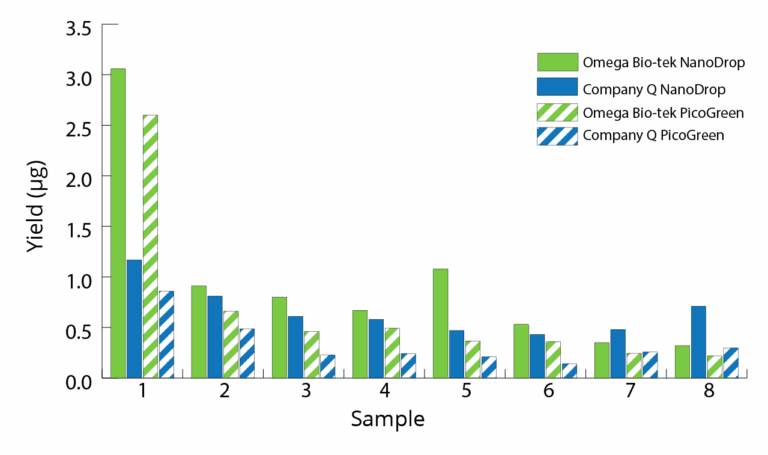
Figure 21. Eight subjects self-collected 16 cheek swab samples, swabbing one sample from each cheek. DNA was extracted using the Mag-Bind® Blood & Tissue DNA HDQ 96 Kit automated on the KingFisher Flex 96. 6 out of 8 samples extracted using the Mag-Bind® Blood & Tissue DNA HDQ 96 Kit result in higher yield when compared to Company Q.
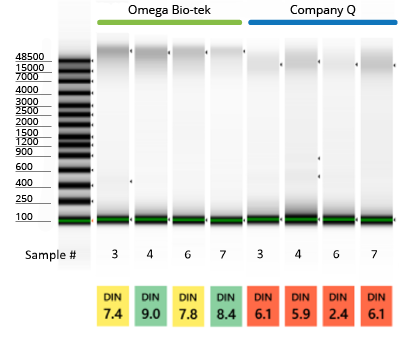
Figure 22. DNA was extracted from cheek swabs using the Mag-Bind® Blood & Tissue HDQ 96 Kit automated on the KingFisher Flex 96. The Mag-Bind® Blood & Tissue DNA HDQ 96 Kit elutes high integrity DNA, as shown by the DIN scores from TapeStation Analysis, out performing Company Q’s Kit.
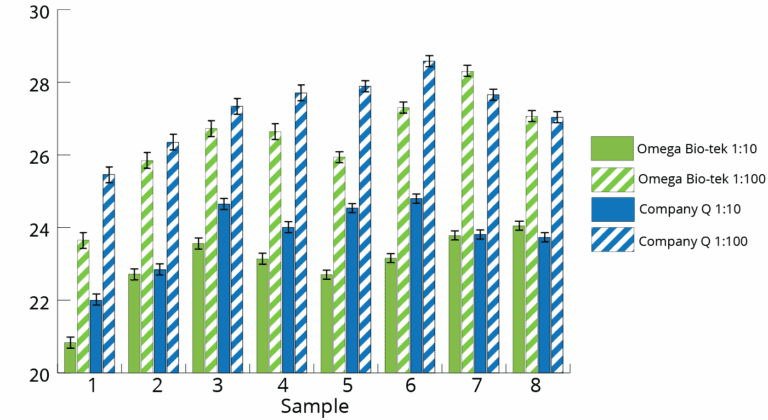
Figure 23. DNA was extracted from cheek swabs using the Mag-Bind® Blood & Tissue HDQ 96 Kit automated on the KingFisher Flex 96. qPCR analysis shows ΔCts are comparable and ~3.3, indicating no qPCR inhibition.
Yes, they can be made into a master mix before starting the experiment.
Yes. See the protocol modification below. Please be aware we have not validated this protocol.
The Mag-Bind particles are stable at room temperature for 2 weeks.